
In the world of luxury weddings, perfection is the only acceptable standard. Every detail undergoes intense scrutiny. The floral arrangements must be fresh. The lighting must be cinematic. However, one critical element often determines the final quality of the wedding memories: the wedding stage LED displays.
For professional photographers and videographers, a low-quality screen is a nightmare. It creates visual artifacts that ruin expensive shoots. To ensure every frame captured is flawless, one must understand the technical necessity of high refresh rates and high grayscale.
1. The Core Pain Point: Moiré Patterns and Flickering
Photographers often face a devastating issue called the “scan line” effect. You see a beautiful scene through your eyes. However, the camera captures ugly black bars. This happens because the LED screen’s refresh rate is too low.
Understanding Refresh Rate (Hz)
The refresh rate refers to how many times per second the screen draws data. Most standard screens operate at 1,920Hz. While this looks fine to the human eye, it fails under a camera lens. High-end wedding stage LED displays utilize a 3,840Hz refresh rate or higher.
The Shutter Speed Conflict
Professional wedding photographers use fast shutter speeds to capture movement. If the camera shutter opens and closes faster than the screen refreshes, it catches the “blackout” period. This results in:
- Horizontal black lines.
- Ghosting images.
- Unstable brightness levels.
By using high-frequency pulse width modulation (PWM) drivers, modular LED screens maintain visual integrity. Even at a 1/2000s shutter speed, the image remains solid and crisp.
2. Solving Color Banding: The Power of Grayscale (Bit Depth)
Luxury weddings often feature subtle gradients. Think of a sunset background or soft champagne hues. On a low-quality screen, these gradients look like “steps” or “stripes.” This is known as color banding.
What is Grayscale?
Grayscale determines the number of color shades a screen can produce. A standard 8-bit screen offers 256 levels of brightness per color. In contrast, a professional 14-bit or 16-bit LED display provides up to 65,536 levels.
Why It Matters for Post-Production
Cinematographers shoot wedding films in “Log” profiles to retain detail. If the wedding stage LED displays have low grayscale, the “data” isn’t there. When the editor tries to color grade the footage, the background “breaks.”
- High Grayscale: Ensures smooth transitions in dark areas.
- Deep Colors: Provides a realistic, lifelike canvas for the couple.
- Accuracy: Matches the high-end skin tones captured by CMOS sensors.
3. The Science of the “Perfect Frame.”
How do these parameters interact during a live event? We must look at the relationship between the LED driver IC and the camera sensor.
| Feature | Standard Screen | Luxury Wedding Screen |
| Refresh Rate | 1,920Hz | 3,840Hz – 7,680Hz |
| Grayscale | 10-12 Bit | 14-16 Bit |
| Moiré Effect | High Risk | Minimal/None |
| Photo Quality | Requires Editing | Ready for Print |
Eliminating the Moiré Effect
Beyond refresh rates, pixel pitch plays a role. Modular LED screens with fine pixel pitches (e.g., P1.5 to P2.5) reduce the physical gap between diodes. When combined with high-quality optical masks, these screens diffuse light more evenly. This prevents the camera from “seeing” the individual pixels, which causes the wavy moiré patterns.
4. Investing in Broadcast-Grade Parameters
Why should planners prioritize these specific technical specs? It comes down to the “Final Product.” The live event lasts six hours, but the photos last a lifetime.
Protecting the Brand Reputation
For a high-end wedding vendor, the portfolio is everything. If a photographer delivers a gallery where the background screen is flickering, the client blames the equipment. Using broadcast-grade wedding stage LED displays ensures that every vendor on-site succeeds.
Consistency Across Devices
Modern weddings are shared instantly on social media. Smartphones use aggressive computational photography. These devices often use high shutter speeds automatically. A high-refresh screen ensures that even a guest’s “Instagram Story” looks professional and vibrant.
5. Technical Advantages of Modular Design
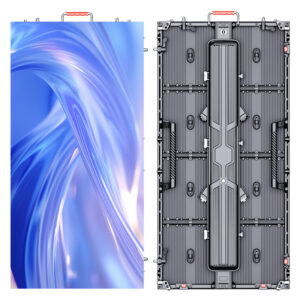
Modular LED technology allows for creative freedom without sacrificing performance.
- Seamless Integration: High-precision cabinets ensure no visible gaps between modules.
- Calibration: Advanced systems allow for pixel-by-pixel brightness and color calibration.
- Thermal Management: Better heat dissipation prevents “color drift” during long ceremonies.
When the hardware maintains its color temperature, the photographer doesn’t have to fix “blue-tinted” backgrounds in every shot. The white balance remains consistent from the first kiss to the last dance.
6. Conclusion: The Invisible Quality
In the premium wedding market, the best technology is invisible. You shouldn’t notice the LED screen. You should only notice the stunning atmosphere it creates.
By choosing screens with 3,840Hz+ refresh rates and 16-bit grayscale, you remove the technical barriers between the moment and the memory.
Investing in these parameters is not just a technical choice. It is a commitment to the ultimate quality of the wedding’s visual legacy.



Add comment