
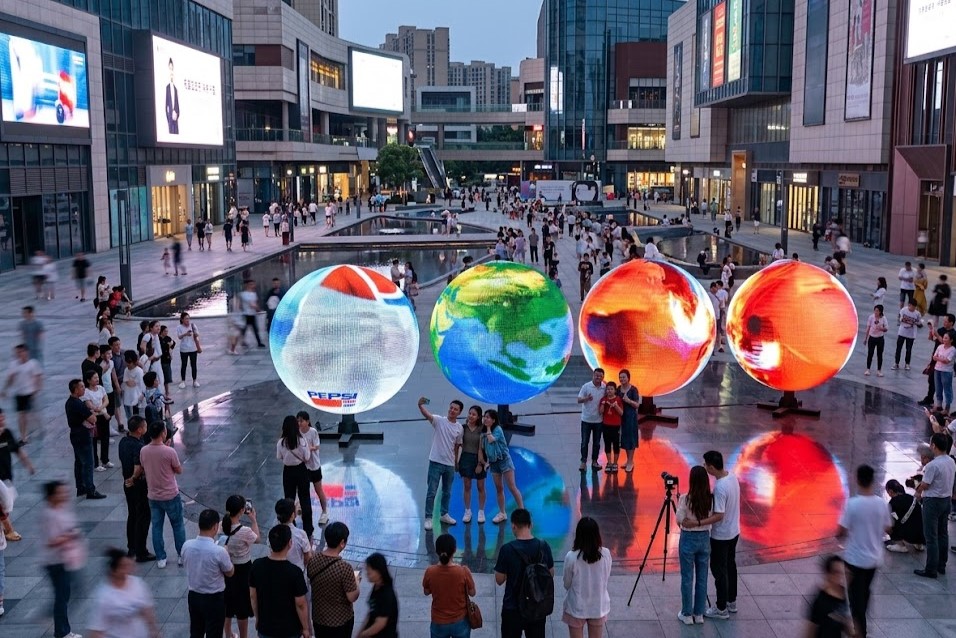
When designing flagship retail spaces, corporate lobbies, corporate experience centers, or public landmarks, architects and interior designers face a critical technical fork in the road regarding digital media integration. The choice usually boils down to a classic dilemma: Do you install a tried-and-true flat video wall, or do you invest in a cutting-edge, 360-degree spherical LED display?
While flat video walls provide excellent front-facing clarity for standard content, they suffer from a major architectural limitation—high focal contrast at the center but degrading immersion at wide peripheral viewing angles. Conversely, a spherical display offers a 360° dead-zone-free viewing experience from any coordinate in a three-dimensional space. This guide provides a functional 9-dimensional decision matrix and behavioral decision tree to help you choose the ideal display for your project specifications.
1. The 9-Dimensional Architectural Decision Matrix
To help project managers look past generic product brochures, this technical matrix evaluates how both display architectures perform across core environmental, financial, and experiential metrics:
| Comparative Dimension | Flat Video Wall | 360° Spherical LED Display | Matrix Winner |
| Optimal Viewing Angles | Direct front-facing orientation ($160^\circ$ cone) | Omnidirectional $360^\circ$ continuous viewing field | Spherical Display |
| Immersion Profile | Directional, flat-plane perspective | Fully wrapped, volumetric encapsulation | Spherical Display |
| Installation & Structural Rigidity | Low-complexity wall anchors / standard bracing | High-complexity internal structural skeleton framing | Flat Video Wall |
| Maintenance Accessibility | Front or rear mechanical access options | Specialized magnetic modules (Front-service mandate) | Spherical Display |
| Per-Square-Meter Capital Cost | Cost-effective, standardized production batches | Premium capital allocation for custom trapezoidal PCBs | Flat Video Wall |
| Content Production Complexity | Low (Standard 16:9 or 32:9 aspect ratios) | High (Requires specialized UV mapping/spherical rendering) | Flat Video Wall |
| Visual Wow Factor | Moderate (Familiar to modern consumers) | Extreme (Functions as a central artistic installation) | Spherical Display |
| Spatial Adaptability | Restricted to two-dimensional vertical plane | Fills three-dimensional volume / fluid suspension | Spherical Display |
| Social Virality & Foot-Traffic Draw | Moderate informational engagement | Restricted to a two-dimensional vertical plane | Spherical Display |
2. Deep-Dive: Spatial Dynamics & the Shifting Viewpoint
To understand why a spherical structure commands a premium, we must analyze how human beings interact with digital media inside a physical envelope.
  Flat Video Wall (Directional Limitation)     360° Spherical Display (Omnidirectional Freedom)
          ┌───────────────────┐                                   ●●●
          │  Flat Screen Base │                              ●       ●
          └───────────────────┘                             ●    ●    ●  <-- View From
           /        │        \                               ●       ●       Any Angle!
          ▼         ▼         ▼                                 ●●●
      [Poor View] [Good View] [Poor View]             [Perfect View 360° Around]
- The Peripheral View Degradation: A traditional flat video wall is a passive backdrop. As a visitor walks past the screen, the image undergoes color shifting and severe contrast drop-off due to extreme viewing angles. The illusion of brand immersion breaks down the moment a visitor steps out of the central viewing sweet spot.
- The Omnidirectional Advantage: A 360-degree immersive display turns the screen into an active architectural anchor. Because the display surface curves seamlessly along all axes, the viewer’s eye is always perpendicular to the light-emitting pixels, regardless of where they stand in the room. This makes it an ideal option for central atrium spaces, open squares, and high-foot-traffic retail crossroads.
3. The Project Sourcing Decision Tree
Selecting the right equipment comes down to balancing your creative ambitions against your structural budget and long-term content strategy. Use this operational checklist to guide your planning:
                                      [Identify Project Priorities]
                                                    │
                 ┌──────────────────────────────────┴──────────────────────────────────┐
                 ▼                                                                     ▼
    [Premium Creative Landmark]                                            [Cost-Effective Messaging]
  Maximum Visual Power + Adequate Budget                                     Standard 2D Text/Video Focus
                 │                                                                     │
                 ▼                                                                     ▼
    [Check Content Capability]                                              [Check Structural Limits]
  Has Access to 3D/UV Motion Designers                                       Simple Wall Surface Mounting
                 │                                                                     │
                 ▼                                                                     ▼
┌──────────────────────────────────┐                                  ┌──────────────────────────────────┐
│   360° Spherical LED Display     │                                  │        Flat Video Wall           │
└──────────────────────────────────┘                                  └──────────────────────────────────┘
Choose a 360° Spherical Display if:
- Your Goal is Shared Virality: You are building an iconic experiential landmark or a destination store where the main objective is driving foot traffic and social media check-ins.
- The Spatial Layout is Open-Concept: The digital installation sits in the center of an open floor plan, three-story atrium, or wide-open reception hall where it will be viewed from multiple floors or approach directions.
- You Have a Dedicated Content Pipeline: Your brand works with or employs creative agencies capable of producing custom 3D anamorphic content tailored for non-planar, spherical mapping coordinates.
Choose a Flat Video Wall if:
- ROI is Budget-Driven: Your budget requires the lowest possible cost per square meter while maximizing total digital surface area.
- Information Overcomes Experience: The screen’s primary job is displaying informational text, data-heavy dashboard analytics, standard corporate video reels, or fast-turnaround ad assets.
- Fast Implementation is Required: The project has a tight construction schedule that cannot accommodate the engineering cycles required for custom geometric sub-frame welding and structural load testing.
4. Real-World Architectural Integration & Case Studies
Global engineering trends prove that spherical LED installations are redefining modern urban spaces. A prime example is the growing adoption of massive spherical displays in world-class entertainment districts and flagship shopping malls worldwide. These installations act as central artistic sculptures that instantly draw crowds and enhance neighboring commercial real estate values.
       [Flagship Atrium Installation Profile]
                 ┌──────────────┐
                 │ Ceiling Mount│
                 └──────┬───────┘
                        │ (High-Tensile Steel Cables)
                       ◢■◣
                     ◢■■■■◣  <-- Custom Curved Modules
                     ◥■■■■◤      Engineered by LIHE
                       ◥■◤
                 ┌──────────────┐
                 │ Floor Atrium │
                 └──────────────┘
For architects executing these cutting-edge layouts, working with a specialized manufacturer like LIHE is essential. Building a perfect sphere requires producing custom trapezoidal, triangular, and curved module shapes rather than standard rectangular tiles. These custom shapes ensure that when the modules are fitted edge-to-edge, the outer skin maintains a uniform pixel pitch across the entire surface, preventing visible panel seams or distorted image lines.
Conclusion: Designing for Next-Generation Spaces
In high-end architectural design, the display medium is not just a screen—it is a core element that defines the texture, energy, and immersion of a physical environment.
Stop limiting your experiential projects to flat, two-dimensional screens that fail to capture a viewer’s attention as they walk past. By analyzing the unique spatial dynamics of your building and utilizing a bold 360-degree immersive display, you turn a digital surface into an iconic, memorable brand statement. Explore LIHE’s premium line of creative LED solutions for retail and architectural engineering today to discover customized displays designed to redefine physical spaces.

Add comment